Showing posts with label New York. Show all posts

Friday, November 15, 2013

NYC Flash Mob Puts the Spotlight on Translated Literature

Be part of the first NYC Flash Mob that spotlights translated literature.

When: TOMORROW, SATURDAY NOV 16th, 2.00PM

Where: Queens International 2013 @ Queens Museum

The Flash Mob is the culmination of the SMUGGLED GOBBLEDYGOOK project that is meant to challenge the dominating mono reading and language culture in the U.S., by "contaminating" the public space with foreign languages, as well as literature translated in English from any of the 138 languages spoken in Queens.

The mob was preceded by Book-Crossing, which will continue till the end of the Queens International (January 19, 2014).

The book-crossing is an ongoing public experiment that trades books over mainstream and off-stream social networks. Local immigrant communities or fans of international literature are invited to smuggle books in translation or in their respective native language into the museum and deposit them in the Flip-House*.

As an extension of the book-crossing, the multilingual flash mob uses the collected books to reproduce the Queens communities as a simultaneous read-aloud. At a precise moment the ‘mob’ starts reading out loud, then finishes exactly five minutes later, as suddenly as it begins. At this point, readers disperse and leave their readings in a specially designated box.

Please, come 10 minutes before the start of the flash mob and either bring your own reading material or pick up a book at the site. There will be a short instruction before the start.

Please, come to share your native language & literature, be it in translation or in an original form. You are as much welcome as a text-performer as just an observer!

Make sure to stay little longer and check the rest of the Smuggle Tactics’ works and get а wider picture of the Queens International exhibition.

Many thanks to everyone who has signed up for the Flash Mob or has donated book(s) so far. We have Armenian, Bulgarian, Check, Chinese, Korean, Finnish, Irish, Japanese, Macedonian, Polish, Spanish, Romanian, Russian, Polish, Turkish presence, including translations, donated from premier publishers of international literatures such as: Absinthe, Accents Publishing, Archipelago, Black Balloon, Dalkey Archive Press, Europa Editions, Grove Atlantic, New Europe Writers, Open Letter Books, Spinning Jennie etc. Special thanks to the Immigrant Movement International and the Queens Library who helped me reach out local communities.

*The Flip-House (visualized below) is the main stage of the Bulgarian Collaborative's Smuggle Tactics exhibition.


Thursday, March 14, 2013

Tom Joyce: Literature… slows down experience to an engageable unit


Jasmina Tacheva Talks with Thomas C. Joyce, Adjunct Professor of English at Canisius College, Buffalo, New York
11/16/2011
Tom Joyce
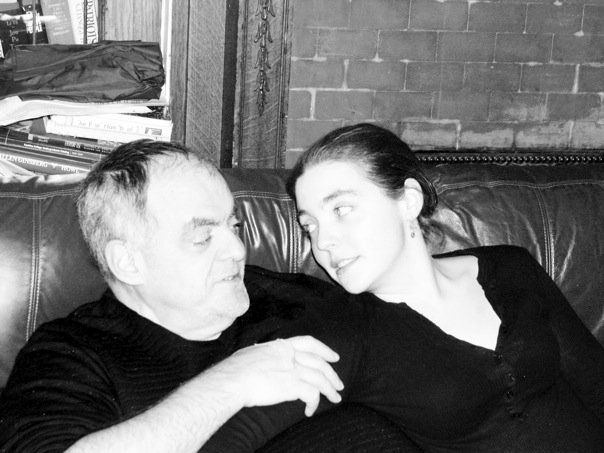
Tom Joyce with his daughter, Gilbert. Photo courtesy of Fiona Joyce.
What do you think literature is and why do we need it in our Hi-Tech, multi-fast, mega-dynamic society?
I will answer in reverse order, because I think why we need literature is part of the definition. We humans live with noise. Mostly we live with habitual noise, but if we are lucky we live with the joyful noise the Bible celebrates. In our fast-paced world, we live with so much noise that we do need a place to rest, a place where experience winnows down and where we become reflective.
Many people misconstrue noise for passion and noise for living an active life. Some of the best web sites I know are over-stimulated mélange of great images that attack the reader at such depth and speed that the watcher becomes even more passive. In the face of a million stimulations at once, the human mind shuts down and shuts out.
Enter Literature, with its great heart for engaging and understanding and meditating over and accepting the world as it is. We need to know what it is that we are giving back when we die.
Literature, which I will define here in an attempt to define, slows down experience to an engageable unit.
Literature is the representation in words of passions, stories, sounds, experiences, and mysteries for the enjoyment, enlightenment, mystification of and challenge to a reader or readers.
As a professor of English of long standing, you reject the traditional notion of teaching as a disengaged teacher’s monologue and initiate a real dialogue between you  the students, and among the students themselves. What is the product of these discussions?
The product of these discussions I feel is to encourage students to break down the wall they feel has been constructed between them and a life of meaning and significance. Students are often both convinced of their own uniqueness and ashamed of being.
Often, a general question about meaning or life will be answered by a cliché reaction, which is simply false in every way. Ask them “Who has more power in relationships, men or women?” and the first response will be, “It is different for everybody.” They say this even though retailers can know by their zip code and age and sex what products they will buy and when.
But if we stay with a question about men and women, which students really express as guys and girls, and we will uncover an enormous amount of anti-girl sentiment. While the students maintain, “everyone is different”, the girls will readily pronounce, “girls are mean.” It seems clear that if girls believe that girls are mean, then the girls will not have the kind of solidarity from which power arises.
I think that the first thought, that everyone is different and therefore unique, is undermined by the second thought that girls as a class are mean. But more than whatever the discussion reveals about contradictions on any particular point, what the discussion reveals is that people pay lip service to individuality while embracing stereotypes and the off shoot of this is a feeling of being overwhelmed and small.
The student feels s/he has nothing to say, so s/he hides behind the collective idiom that “everyone is different”. Of course, there are other problems with this thought, for example, it makes people non-judgmental even where they are caught in a place where they have to make a judgment, so the thought leads to passivity, particularly about political events which really define their hopes and dreams, but which they feel lost to understand and so they rely on the, some people are into politics and that is fine for them, but I don’t care because the political stuff isn’t interesting and doesn’t really effect me (maintaining this, even as they climb into monstrous debt from student loans, even as they have no health insurance, even as the gap in entry level wages for them compared to previous generations is staggeringly set against them).
I think our conversations open the students up to the world in the classroom, and that such opening up is what Literature itself does. (I never know when to capitalize Literature, so I apologize for inconsistent use of L and l in referring to it.) Students are shocked to discover that others have problems and joys and passions, and I think novels and poems and short stories and songs, too, are unique in their ability to empower a person to find his or her identity.
I do not think it is too much to say that Literature as a category leads to the development of a concept of a soul (as do philosophy and religion and some other studies), and then through the experience of the lines, images, situations, stories, expressions, etc. of the works and how those works impact on the emotion of the reader, to the creation or realization of what one’s soul looks like or would look like.
If we imagine literature as a house that is constantly being built on, what is its building block?
Ah! This is such a fun interview with so many ideas rushing into my head, but this question is really great.
The building blocks are words and clusters of words, but there is so much more to it. In one of the essays I received this semester, a student wrote, being true to his generation, that music is different for everyone. That is really untrue. Not everyone responds in the same manner, but music can be described accurately as ‘sad’, ‘uplifting’, ‘regal’, ‘exciting’, etc. Music theory can describe what makes sounds have certain emotions.
The emotional power of words is similar to the emotion power of musical notes. Clusters of words function like clusters of sounds. The writer must find the words to evoke in the reader the emotions and passions that s/he is building in her/his writing. One of the sad things about the study of Literature today is that we do not have enough time to adequately address the emotions that the cluster of words and individual words themselves make. Ironically, students are too burned out after being taught “close reading” in lower grades and especially High Schools.
Tom Joyce
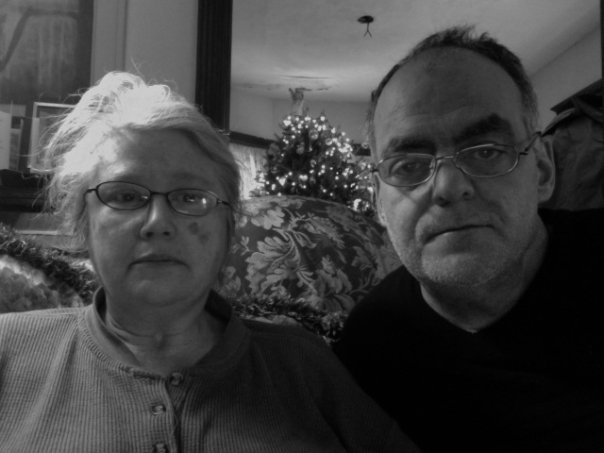
Tom Joyce with his wife, Linda. Photo courtesy of Fiona Joyce.
Teachers rightly pay close attention to the mechanics and workings of passages, but somehow in their insistence that the students see the “deeper meanings” of things, the teachers often convince the students that reading is NOT something that they can do alone. The student will miss too much of the real significance if they just read books and poetry on their own. That is not the message that teachers think they are giving, but way too often that is the message the student hears.
As an aside, I need to explain that English teachers in High School have over a hundred students and they have tasks and measures that they have to hit, The teachers have to teach students to write certain formulaic things for the essay tests that will be graded by other teachers who will read hundreds of essays and have rubrics that demand a certain conformity of thought and style. Teachers do not have time to allow students to be wrong, and since all true reading is in part a misreading, the students often do not learn to love reading and writing, they learn how to form thesis driven five paragraph essays in which they pay homage to the deeper meanings of things, all the while ignoring the mystery and the pleasure which reside both on the surface and especially within the inner layers and suggestions and hints and complexities’ of literature.
A poet and writer named Sandy Dedo has talked to me often of a theory she has about literature that turns on the mystery that abides within some works even after you know them well. That kind of engagement with literature is perhaps beyond high school students, but they are actively discouraged by the current system of teaching conformity to the rubrics upon which the student’s reading and writing will be rigidly graded.
Is it appropriate to talk about a unified body of literature that permeates the entire world, or is it better to think of literature as an ensemble of the literatures of various countries and cultures? How does literature differ from nation to nation; from century to century?
This is another great question that is almost too big to answer. I think it would be wonderful if we could construct a Canon, which included the best writing from every country, but such a canon would be immense.
I will eventually sketch an answer to the question of how literature differs from nation to nation and from century to century, but for now, I will write a short hand answer that will be more attempt than actuality.
I was lucky enough to go to school when American schools still taught Latin. The greatest thing about Latin was the works we read, especially Catullus and The Aeneid. My teachers, Fr, Conroy, S. J. and then Fr. Roslivich, S. J. were both impassioned teachers who believed that 16, 17, and 18 year old boys had a soul that would respond to poetry, and they were right. I remember Dido’s suicide and funeral, and I remember how modern Catullus seemed with his complaints about the evanescence of romantic, and for Catullus even sexual love. And I remember Catullus’s elegy for his brother, ‘ave atque vale’, and I remember his ‘Odi et amo’ and the fun of translating, I love and I hate, why do I do these things perhaps you ask. I do not know, but I do love sometimes and hate sometimes and life brings me excruciating pain from my passion.
That is a free translation with too many words, and that is the thing we need to understand about bringing life from another era into our life. It might be that we understand the poem perfectly, but it is also possible that the writer and his audience all those years ago would say, no, that is not even close to what we felt.
So there is a certain imperialist impulse even behind the good intention of learning from and respecting writers of another day or place. We need to be humble and realize we are getting a misreading, even of we do our best. But I agree with Harold Bloom that all reading is an action and always in a real sense a misreading, he calls it misprision, and so we should go ahead and try to engage writing from every corner and time of the Earth.
For Sartre, the literary work exists only through the collaboration of writer and reader: “Creation can find its fulfillment only in reading, since the artist must entrust to another the job of carrying out what he has begun.” Do you agree with this statement?
Yes, I do emphatically! I have had the great pleasure of reading an anthology of Bulgarian writers in translation. One poem in particular speaks to my soul, and I read it every day. The poem, by Binyo Ivanov is translated: “The wind is coming, and I love you,/dawn lifts an arm, the sunset fades,/a cloud is drying, and I love you.” The poem immediately struck me and raised so many passions inside me, and yet I knew from the lines about the “Balkan mountain bears he stalked” and the mention of an “eternal war with vermin” complete with a footnote informing a western reader that vermin also means “pagans” in Bulgarian, that the poem had dimensions which only study would bring me.
As I said in answer four above, all reading is a form of misreading and once an author writes something and gets it out there, s/he does lose control of how it will be experienced. It is not quite that case that the work will be “different for everyone”, but the work will change meaning over time and will strike some people with great passion and will barely stop long enough to even linger with another reader. What Sartre probably had in mind was an active audience of left wing philosophy savvy thinkers who would embrace his ideas and make his ideas their own and then perceive other readings through the lens he wanted to impose on the world, but what has happened is that we have seen that the readers see things in the text that the author did not consciously realize were there.
We make the text our own in some ways, if the author is lucky. Like language itself, which has to change over time in order to escape being a dying or dead language, so too texts must somehow change to attract new readers. The Italian philosopher and thinker Giorgio Agamben wrote that every generation produces a new reading of Dante and his Divine Comedy. This idea may offend purists, but it seems to me that the great works do last for a long time because when new readers come to them they recreate the work in the image of their own time.
Hail and farewell brother Catullus, you touched me when I was 17 and now that I am an older and completely different man, you still touch me, you still offer me a silent place to discover who I am, you still carry the mystery of a great work in your lines, whether translated or read aloud in the original. That is what we mean when we say we collaborate to create the text, and I would say the author is the most important part of that collaboration. But I get ahead of myself, and that is for another conversation.
Originally published on www.public-republic.net

Thursday, January 24, 2013

A Talk with Artist Yana Dimitrova

By Jasmina Tacheva
Yana Dimitrova

Hi Yana! How is everything going – did Sandy disrupt any of your plans?
Luckily we have been safe and sound in my part of Brooklyn, only lots of scary winds… 
the “post” Sandy period I think has been much more difficult to cope with in the entire 
city, and it will take a long time for a full recovery.
Common Frequency
Yana Dimitrova and Sebastien Sanz de Santamaria: Common Frequency
atRadiator Gallery
Common Frequency – an exhibition at Radiator Gallery, NYC, featured 
some of your works last month. What was your overall impression of the
 exhibition and can you tell us a bit more about the works you presented 
there?
The basis of the curatorial idea was in my opinion an interesting one. The show was 
curated of creative couples, and it was not necessary that both partners were visual 
artists. It really engaged everyone outside of the individual, and into creating work in 
relation to one another. Ultimately it promoted a rather collective thinking, which to 
me is exciting and very important.
Common Frequency
Common Frequency at Radiator Gallery
This conceptual set up made my partner and I realize how much we influence each 
other, even if not both of us are practicing artist. My work is often inspired through 
conversation and dialogue or I often discuss my ideas with my partner sometimes just 
to understand what I am trying to do, and his response often can push things in 
another direction.
I find that such mindset really creates a fluid, ever evolving matter, and in such most 
exciting things happen. The works that I exhibited were in fact a very direct depiction 
of our domestic life in the United States. The “Eat Faster” is a table cloth with a 
classical pattern with an embroidered text stating “eat faster” interlocked in the design 
of the fabric.
Common FrequencyCommon Frequency at Radiator Gallery
I wanted to suggest the inability of such type of domestic life to sustain, while we eat 
we send e-mails, we work we talk about work, particularly in such place as New York 
you tend to just basically eat faster then ever. With this piece I was interested in 
contradicting the historical relevance of the pattern, the function of a table cloth and its
very inability to sustain itself in that context.
You were born in Bulgaria. In what ways do you think your background 
influences your art?
Recently I have been thinking about what type of work I would have made if I never
 left Bulgaria, and I am certain it will be very different than what I am making at the 
moment. I guess as an art student in the U.S., I went through a number of waves, and 
tendencies, concepts.
Starting from ideas of Melancholy and Nostalgia to political and ideological conceptual 
work, and I find my background prominent in almost everything I have created. I 
moved to the United States with my entire family and this really fractured my 
understanding and idea of “home”. Whichever country I visit, I feel that there is 
something missing, on one side the parents, on the other the culture.
In such position I found myself thinking of concepts of liminality and in-between. The
 space between possibly reality and fiction, home and not, things that are not black or 
white, a state very exciting and rich in many ways as it has endless possibilities. These 
concepts have been key to my practice and conceptual motivation for most of the time
 I have been abroad, so Yes my background is definitely in the very root of my work.
Additionally I am always comparing every day for nearly 11 years now how different 
things are, with just the entire surrounding and understanding of the world, 
mentality…etc.
How did you decide to become an artist?
I don’t think I ever made a conscious decision, but it feels that I have rather been 
following a way that I always knew is the right choice for me. I vaguely remember one 
day in the kindergarten when we had free drawing time, and the teacher, rather 
“Comrade” at the time, kept expressing how my drawing was the best of all.
My friend who was sitting next to me said: “If you draw this pin exactly as it looks, the 
teacher is right, otherwise I don’t believe you!” So I had to prove that I really can draw, 
and I put forth all of my concentration and drew the pin ( it was of a penguin) and it 
looked exactly the same to me at that time. The girl was so impressed- “OK I believe 
you! It looks exactly the same!” Meanwhile the whole row of students turned at me 
and started asking me to draw those things; it turned into a crazy moment of 
recognition at the age of 6. Then I guess I kept going on and on…
You were educated both in Bulgaria and the United States. Where there 
any significant differences in the teaching methods you were exposed to in 
the two countries?
Indeed, I did feel that the difference was prominent. The very main difference, I think, 
was the approach. In Bulgarian academia, the general idea was that you need to 
master all representational techniques in order to be creative. Here we had a few very 
basic drawing and design introductions but generally after that the big question was: 
what is the idea that supports the very specificity of the use of paint?
Why even paint or draw or any of it? I don’t know if one is better than the other, I
 think sometimes you need more strict structure in order to create something exciting 
in response to that. I find it also problematic that a lot of art schools in the United 
States are very expensive, and that promotes a different kind of thinking.
In my experience after I moved to the U.S. I felt that colleagues and professors were 
too excited about how accurately I could paint in a representational style, and for a lot 
of the students this was a goal. For me the goal was to step away from that and it 
created a sense of confusion in the beginning until I set my own goals.
Jan-Michel Basquiat famously said: “I don’t think about art when I’m 
working. I try to think about life.” What would your response to that be?
I think that the boundary is totally blurred. The world, politics, economics, 
demographics, ideology, your daily coffee, your train ride… it is a way you see the 
world not separate from the world. Everything is interrelated in the means of 
creativity, in my opinion and that connects to exploring different ideas, different 
identities, challenge the world, yourself, others, systems, color, everything. Those 
connections need to exist in order to shape critical thinking in not only the artist’s 
mind but everyone else.
Your works have been exhibited both in America and Europe. Does the 
way the audience perceive your art differ from country to country or even 
from city to city?
Yes, and there are so many factors for that. Of course people respond to different 
things differently, depends on the work and also the context. But generally there is a 
difference in taste and aesthetic that people identify with depending on their 
surroundings, environment, access to information.
This very difference makes things even more exciting to me. The last exhibition I had 
in Atlanta, GA I deliberately created work that might be a bit more critical specifically 
to the demographics there, and this set a tone for an interesting reaction.
Can you tell us about your work space and your creative process? What 
spaces, surroundings or times of the day prove to be most productive for 
you?
I am always ready to create; generally I am so busy all the time that when I am at my 
studio I make sure I am on point. I teach art and mural painting during the day and try 
to spend the early mornings and nights in the studio. I am lucky to say that my space is 
very unique. I work in an old military base which was built in 1917, it was 
predominantly used for redistribution and storing of supplies.
The experience of walking through a tunnel next to a train and surrounded of freight
 balconies is very interesting and inspiring sometimes. It is also very close to the 
Hudson and you can see the statue of liberty, Manhattan, New Jersey, Staten island 
and a lot of cruise ships and police ferries. You can walk on the pier where there are so
 many fishermen, mostly immigrants. I really find it inspiring. You really can see and 
sense the history there, which as a European, it is not something you can experience 
anywhere in the U.S. Funny enough, most of my visitors always associate the building 
with my background coming from eastern Europe.
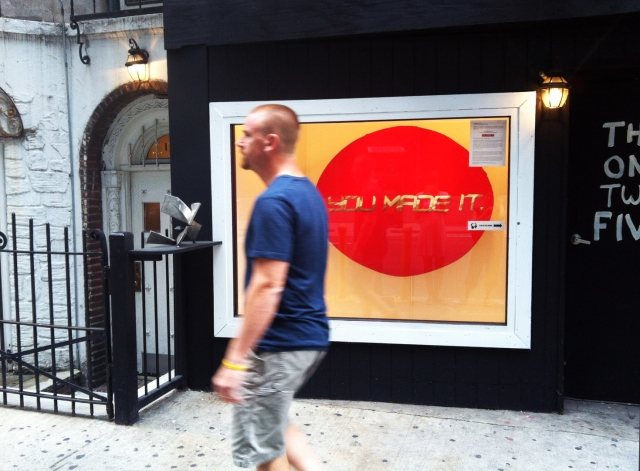
No too long ago “The Window at 125” showed your installation “You Made 
It.” – a work you designed specifically for that site and with which you ask 
a very important question: “You made it. And now what?”. What would 
your own answer to this be? And could you tell us how you specifically 
“made it” – to the United States, to NYC, to the galleries there – what were 
some of the greatest challenges you encountered on your way and what 
does success mean to you? In other words, when would you feel 
comfortable to tell yourself that you made it?
I think we live in a society that does not want you to believe that you did in fact make
 it, simply because if you did, you will have to feel satisfied. Obviously the current 
consumerist logic does not allow you to be even remotely in that mindset.
 Additionally, if you “made it” it means you need to stop, or start over and both of 
those are extremely difficult ideas to grasp. In my experience I am not concerned with 
“making it” but probably just the idea of not stopping.
I am always running and part of me thinks that because I left my country it is much
 too hard to stop. Productivity, being efficient, being “happy” all of these concepts for 
what might construct a successful person, or a great man who will be making great 
history, are some I often criticize and question in my work. All of these concepts to me 
are in the way some times of human advancing, if you start analyzing the “here and 
now” and do this in a much more detached of yourself way that might be just as valid 
as success.
It is also another very self-motivated idea, in which one competitively excludes 
themself from the whole, and in such remains a split. I walk to my studio I say hello to 
the coffee lady, I get in my space I have time to think and create, I engage in a good 
conversation, I often teach, I have a platform to exhibit and share some of my ideas, 
that is to me success; In ways, appreciating the current while positively engaging
 in the future.
Space seems to play a crucial role in your work – both in your paintings 
and installations: landscapes, an empty swimming pool, interior and 
exterior of buildings, etc. – do you think they have their own meaning and 
existence even when they are completely desolate and abandoned by 
humans?
Yes, space is the very invisible matter in which ideology, politics and history lingers. It 
is a very psychologically rich matter; the way space is arranged can manipulate the 
human experience weather you are in the space or observing it. Previously I have been 
so fascinated with the idea of “space in between” or liminality, space in which anything 
can happen or not. Your space immediately reflects on your mindset, it is inevitable.
I often portray the space as a dislocated one, or as a deceptive space, where you feel 
like you could walk in due to the scale but after “entering” such space you realize it is 
criticizing you, and this can be very discomforting. I think this is an important aspect 
of my work, the sense of discomfort in order to experience this very sense of transition.
What message does your art communicate and what do you think the role 
of the artist in our world should be and especially of the “dislocated”, 
traveling artist?
This is a very relevant question, I think it is important that when you do travel from 
one place to another you are aware of how much each side can benefit and work in an 
engaging way, and not as if you never left your previous location. We have been raised 
in a system different than the one in the United States and I find that very interesting 
as a point of reference when we talk about the current times, the world or the future.
The angle in which we see the world is different due to that experience imbedded in us 
(or at least my generation), maybe we are able to see and experience the world from 
many exciting points and facets. With my work I often try to questions those very ideas 
of dislocation, disappointment and effort to success outside of your home place, and 
therefore completely decompose the meaning of the word success.
My aim is to have a critical discussion, not necessarily propose a solution. I think the 
artist’s role is to critically engage in the world, and through a unique way of 
communication suggest a different perspective of everything, sometimes maybe 
shocking, in order to stir people’s idea an perception of the world.
I Don’t Think It’s Funny
You created a unique book called “I Don’t Think That’s Funny”. In it, you 
translate Bulgarian anecdotes into English and accompany them with 
illustrations. Why don’t you think they’re not funny?:) And what’s the 
backstory on this project – how did you come up with the idea?
I Don’t Think That’s Funny
There are so many words and anecdotes that are culturally untranslatable. 
I experience that with Seb, my partner, all the time. He is laughing at how not funny a 
lot of the jokes I tell him are. Another example of lost in translation as a reaction to the 
globalized world, it can’t really translate all the way. It is ridiculous how many times I 
have been in meetings or just with friends in which I would try to say something funny 
and it ends up being totally a disaster, and I thought why not put all of these in a book.
I Don’t Think That’s Funny
I also think there is a very big difference of mentality and what we actually find funny. 
Bulgarian sense of humor is very dark at times and cynical, and here the general crowd 
wouldn’t really think that things that are really taboo are that funny. During the 
opening Seb and I created a collaborative performance, in which we set up a 
microphone a simple spot light and invited the audience to come and recite a joke that 
is not funny. It was actually pretty funny.
I Don’t Think That’s Funny
What are you currently working on?
I Don’t Think That’s Funny
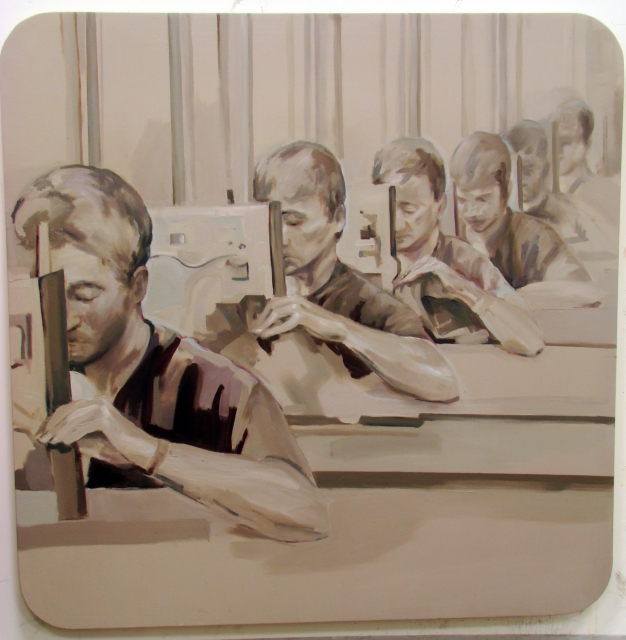
Currently I am finishing a project based on factory workers’ survey I developed, and in 
return I am making works based on their requirements. I am really excited to be 
almost done with it, but I will have to spare the details until I am completely finished.
I Don’t Think That’s Funny
I am also preparing to travel to Amsterdam for 2 month residency program with my 
partner. It is very exciting and a bit frightening to leave New York for this long, but we 
have to keep moving forward wherever that might be! :)
This Interview originally appeared on Public-Republic.net